By Dr. Brad Johnson
If there’s one area of leadership we struggle with most, it’s conflict. Not instruction. Not vision. Not strategy.
And especially in education, conflict is often labeled as bad.
It’s whispered about. Avoided. Watered down.
Why? Because this profession tends to attract highly agreeable people—compassionate, service-oriented, deeply relational.
The kind of people who struggle with saying no, setting boundaries, or stepping into uncomfortable conversations—not because they ignore problems, but because they don’t want to create tension or seem confrontational.
But here’s the problem: Avoidance doesn’t build trust. It buries dysfunction.
When conflict is ignored, it doesn’t disappear. It festers.
Culture erodes. Morale drops. Resentment takes root.
And suddenly you’ve got silent disengagement instead of open collaboration.
The truth is, conflict is neither good nor bad.
It’s neutral. What makes the difference is how it’s handled.
Handled poorly? It damages relationships.
Handled well? It strengthens them.
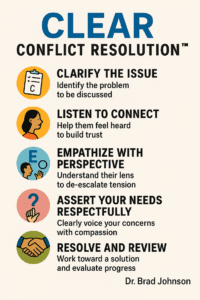
That’s why I created the CLEAR Conflict Resolution™ model.
Not to manage tension—but to transform it.
It’s about leading with clarity, compassion, and relational intelligence (RQ)—because real leadership doesn’t avoid hard conversations.
It leans in and navigates them with purpose.
🔹 C – Clarify the Issue
Focus on the facts—not the frustration. The issue, not the individual.
Before you speak, get clear. Unclear leadership invites resentment, confusion, and gossip. Every minute spent assuming is a minute wasted.
Most people wait until they’re emotionally charged to address conflict—and by then, it’s too late.
They stop addressing the problem and start attacking the person.
That’s when damage is done.
Clarity is your safeguard. It anchors the conversation in facts, not feelings. In issues, not identities.
You’re not here to win—you’re here to lead.
Strategy for Leaders:
- Write down the actual issue. What happened? What’s the impact?
- Ask yourself: Is this about a one-time event or an ongoing pattern?
- Check your state. If you’re still heated, wait. If you’re rehearsing a take-down, immediately pause.
“Focus on the issue, not the individual. Focus on the future, not the friction.”
🔹 L – Listen to Connect
Don’t just hear. Make them feel heard.
Most leaders listen to respond. Great leaders listen to connect.
This step isn’t about nodding politely or waiting for your turn to speak.
It’s about making the other person feel genuinely seen and valued.
It’s empathy in action—stepping into their perspective long enough to understand not just their words, but their emotion and intent.
Because when people feel truly heard, they stop defending and start engaging. That’s where the shift happens.
Strategy for Leaders:
- Start with open space. “Help me understand how you see this.” Then be silent.
- Listen with your eyes, not just your ears. Posture, tone, expression—everything speaks.
- Use reflective language. “What I’m hearing is…” or “That sounds frustrating—tell me more.”
“Listening to connect means listening with empathy, not agenda.
Because connection isn’t built when you speak—it’s built when they feel understood.”
🔹 E – Empathize with Perspective
Understanding their viewpoint doesn’t mean surrendering yours.
Empathy doesn’t erase standards—it enforces humanity.
Step into their shoes. See how the situation feels from their side.
You don’t have to agree to understand.
But you do have to understand to lead.
Understanding their lens helps de-escalate defensiveness.
When people feel seen—not cornered—they lower their guard. And when defenses drop, dialogue opens.
Leaders who dismiss perspective damage connection.
Leaders who consider it—even while holding the line—build trust that lasts.
Strategy for Leaders:
- Ask intentional questions. “How did that affect you?” or “What felt unfair from your view?”
- Acknowledge without over-apologizing. “I can see how that came across…” goes a long way.
- Balance empathy with clarity. You can validate feelings and still guide accountability.
“Empathy isn’t weakness.
It’s the awareness that gives your authority meaning.”
“You’re not confronting people—you’re confronting problems.”
🔹 A – Assert Your Needs Respectfully
Clear voice. Respectful tone. Steady boundaries.
Being nice is easy. Being clear and kind is leadership.
Many educators—especially those high in agreeableness—struggle here.
They’re naturally others-focused. They care deeply about harmony, making them incredible team players.
But that strength can backfire when it keeps them silent about their own needs.
They may not know how to ask for support, draw a line, or even say “no” without guilt.
Here’s the truth:
Assertiveness is not the opposite of kindness. It’s the foundation of healthy relationships.
And compassion doesn’t mean caving. It means showing respect for yourself and for others—by being honest, direct, and human.
Assertiveness is not aggression. It’s ownership—spoken calmly and confidently.
Strategy for Leaders:
- Use “I” language. “I need us to…” lands better than “You need to…”
- State expectations and limits. Then hold them. Respectfully. Without apology.
- Stay grounded, even if emotions escalate. Your calm is their anchor.
- Practice saying it out loud first. Many agreeable leaders struggle until they rehearse it.
“You don’t have to shout to be strong.
You just have to stand steady.”
🔹 R – Resolve and Review
Conflict isn’t resolved when the conversation ends.
It’s resolved when trust rebuilds.
This is where most leaders stop—and it’s where great leaders lean in.
Following up shows you care. It proves the relationship matters more than the meeting. And it helps ensure change actually sticks.
Strategy for Leaders:
- Schedule a check-in. “Let’s reconnect next week” makes it real.
- Notice progress. Reinforce what’s better.
- If patterns repeat, act early. Don’t let it reset to dysfunction.
“If you don’t review it, you’ll repeat it.”
And When You Lead with CLEAR™…
Something powerful happens.
You stop walking on eggshells.
You stop managing around problems and start leading through them.
You stop confusing kindness with silence—and start realizing that the most respectful thing you can do for someone… is to be honest with them.
When conflict is addressed CLEARly, it doesn’t divide—it develops.
Handled the right way, conflict brings:
• Stronger, more trusting relationships
• Clearer expectations and accountability
• A culture of ownership instead of blame
• Improved communication across your team
• Better long-term decisions
• More emotional safety—not less
Because when people feel heard, valued, and guided with clarity—not shame—they don’t shut down.
They lean in. They grow. They stay.
“If you avoid conflict to keep the peace,
you start a war within your culture.”
You don’t need to be aggressive. You don’t need to be passive.
You need to be clear. You need to be compassionate. And you need to lead with RQ.
“Conflict doesn’t ruin culture. Avoiding it does. Lead with clarity. Lead with courage. Lead with CLEAR.™