In many school systems, leadership roles are treated as interchangeable.
A strong elementary principal might be moved to a middle school. A high school assistant principal might be placed in charge of an elementary building. The assumption is simple: good leadership is good leadership.
But anyone who has worked across grade levels knows the reality is far more complicated.
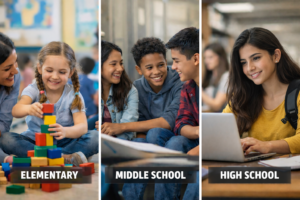
Leading an elementary school, a middle school, and a high school are not simply variations of the same job. In many ways, they are three fundamentally different leadership challenges.
Not because of curriculum.
Because of human development.
Five-year-olds, thirteen-year-olds, and seventeen-year-olds are navigating completely different stages of growth—emotionally, socially, and cognitively. Their motivations, behaviors, and needs reflect those stages.
Which means the most effective leaders understand something many systems overlook:
Education is not a technical system.
It is a human system.
Technical Systems vs. Human Systems
A technical system is the kind of system you see in factories, engineering environments, or assembly lines.
When something goes wrong in a technical system, the solution is usually mechanical.
A machine breaks—you replace the part.
A process slows down—you redesign the workflow.
The output drops—you adjust the inputs.
Technical systems respond well to procedures, checklists, and standardization.
Factories work this way.
Airplanes work this way.
Computer networks work this way.
But schools are not factories, and students are not products moving down an assembly line.
Schools are what leadership scholars describe as adaptive or human systems—organizations built around people, relationships, emotions, identity, and growth. Problems inside human systems rarely have purely technical solutions.
You cannot spreadsheet your way into trust.
You cannot checklist your way into belonging.
You cannot standardize identity development.
Human systems require leadership that understands people.
And in schools, understanding people begins with understanding how students develop.
Elementary Schools: Leaders Must Understand Child Development
Elementary schools are where the foundation of learning and belonging is built. At this stage, leadership requires a deep understanding of child development.
Young children are still developing the cognitive and emotional systems that make learning possible. Research from developmental psychologist Jean Piaget shows that children in the early years think in concrete ways and learn best through experiences that are social, interactive, and connected to the real world.
In other words, learning is not just academic in the early grades—it is developmental.
Children are learning how to regulate emotions, communicate through language, build friendships, and explore ideas through hands-on experiences.
Play-based learning, conversation, movement, and creativity are not distractions from learning at this age.
They are how learning happens.
Strong elementary principals constantly ask questions like:
Are classrooms developmentally appropriate?
Are children moving, exploring, talking, and creating?
Are teachers building relationships before rigor?
Because when children feel safe, curious, and connected, learning accelerates.
Middle Schools: Leaders Must Understand Identity
If elementary school is about development, middle school is about identity.
Early adolescence is one of the most socially intense stages of life. Psychologist Erik Erikson described this period as the struggle between identity and role confusion, when young people begin forming a clearer sense of who they are and where they belong.
Peer relationships suddenly become powerful. Students become deeply aware of how they are perceived by others. Social belonging and reputation begin to shape behavior in profound ways.
Anyone who has worked in a middle school knows that academics are only part of the story.
Students are also asking a deeper question:
Who am I—and where do I fit?
Schools that ignore this reality often spend enormous time trying to control behavior. Schools that understand it focus instead on connection.
Strong middle schools prioritize advisory systems, mentoring relationships, and classroom environments where students feel known and valued.
The most effective middle school leaders often ask:
Do students feel seen and connected?
Are mentoring relationships strong?
Are we channeling peer influence in positive ways?
Middle schools succeed or struggle largely based on belonging and relationships.
High Schools: Leaders Must Understand Purpose
By high school, another shift begins to take place.
Students start thinking more seriously about the future and their place in the world. According to developmental research, this stage allows young people to reason abstractly, evaluate possibilities, and imagine multiple paths forward.
High school is where students begin connecting learning to purpose.
They start asking questions like:
What am I good at?
What do I care about?
Where am I going after graduation?
The most effective high schools create environments where students can explore these questions through meaningful experiences—advanced coursework, career pathways, internships, service opportunities, and creative pursuits that allow students to discover their strengths.
At this stage, leadership is not just about graduation requirements.
It is about helping students build a future they believe in.
Which means strong high school leaders often ask:
Are students discovering their strengths and passions?
Are we preparing them for life—not just tests?
Do students see relevance in what they are learning?
When students see purpose, motivation changes.
Learning stops feeling like compliance and begins to feel like preparation.
The Leadership Lesson Schools Often Miss
Too often, school leadership conversations revolve around technical solutions.
New programs.
New policies.
New evaluation systems.
New data dashboards.
But most challenges inside schools are not technical problems.
They are human ones.
Students disengage when they feel unseen.
Teachers burn out when relationships erode.
Culture weakens when trust disappears.
No checklist fixes that.
Understanding people does.
The best principals understand something simple:
Elementary schools are about development.
Middle schools are about identity.
High schools are about purpose.
And leadership changes depending on the stage of life students are navigating.
Because the truth is simple, even if systems often forget it:
You can manage a technical system.
But you must lead a human one.
Invite Dr. Brad Johnson to Speak
Dr. Brad Johnson is an international keynote speaker focused on relational leadership, trust, and school culture. His presentations inspire educators and remind leaders that education is ultimately a human endeavor.
For speaking inquiries, visit DoctorBradJohnson.com/contact